12 Khaki Utility Spring Outfits for Women With Pleated Trousers and Field Jackets
Khaki trousers under a khaki jacket can flatten into one tan block, and the fix is usually smaller than a new purchase. Keep the jacket and trousers at least one shade apart, then let a shirt color, a shoe color or a dark top make the outfit look planned.
These twelve formulas name the shade, the tuck, the shoe and the hem for each combination, so you can pick the one that fits your day and shop only the missing piece. Before you buy any pleated pair, sit down in them. The pleats should stay closed and the pockets should lie flat.
Spring adds a second test, because a cool morning and a warm afternoon can share one day, so the jackets here are lightly lined or unlined and easy to carry.
1. Stone Pleats and White Poplin
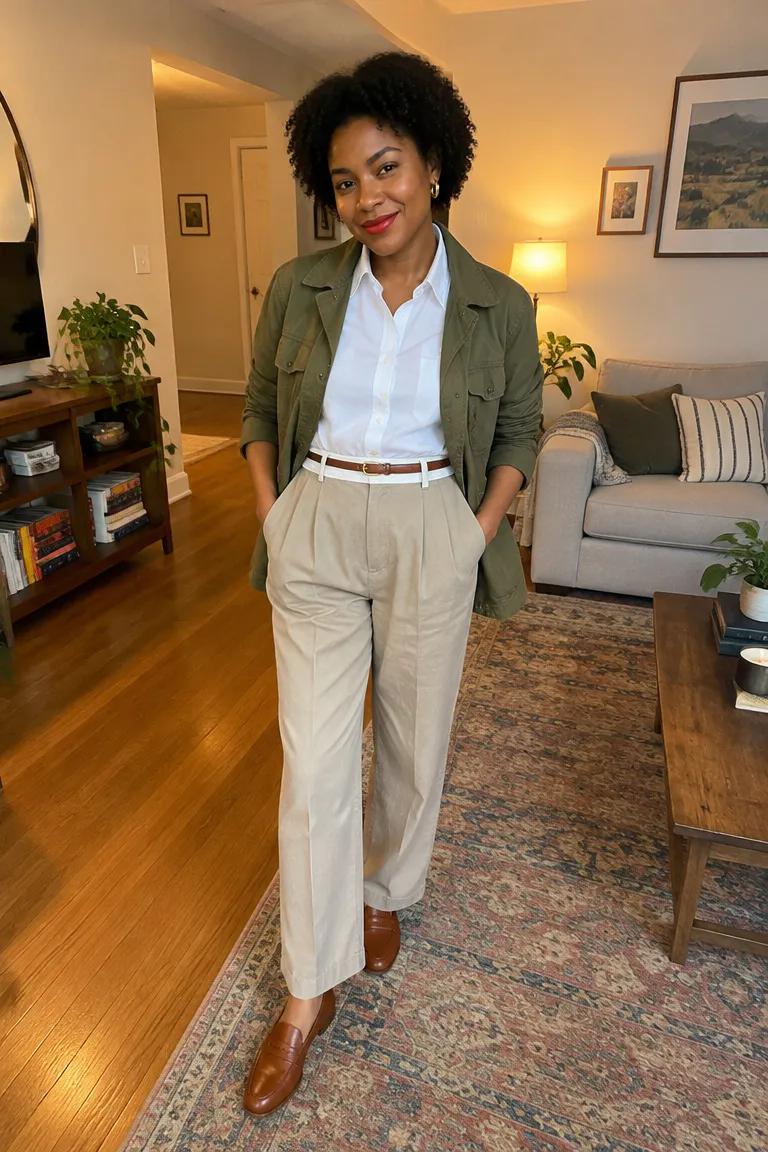
- Best for: Errands, casual offices and a weekend lunch when you want one outfit you can repeat with small changes.
- Wear it with: A thin brown leather belt, cognac loafers, a white poplin shirt with the top button open, and a lightly lined olive field jacket worn open.
- Fit check: Stand and sit in the trousers. The pleats should stay closed and the hip pockets should lie flat. If the pockets bow open, go up a size or ask a tailor about the waist and seat. Push the jacket sleeves to just below the elbow so the poplin cuff shows at the wrist.
- Weather swap: On a mild afternoon, take the jacket off and roll the shirt sleeves twice. On a cool morning, put a thin crewneck knit under the shirt collar and keep the jacket on.
This is the outfit to build first, because every piece in it will work again in the other eleven. A full tuck suits it. Crisp poplin lies smooth under a belt, and a straight-leg pleat falls cleanly from the waist without extra fabric at the hip.
Put the belt at your natural waist, not on the hip bones, so the pleats open from the right spot. Cognac loafers add warmth to the stone and olive, and the white shirt keeps the whole palette from going muddy.
Jacket sleeves cause most of the trouble here. Long field-jacket sleeves swallow the wrist and hide the shirt, which makes the outfit look heavier than it is.
- Tuck the poplin all the way around and smooth the front.
- Fasten the belt, then check that no pleat is pulled open.
- Push the jacket sleeves up past the wrist, so the shirt cuff shows below the jacket cuff.
2. Powder Blue Counterweight
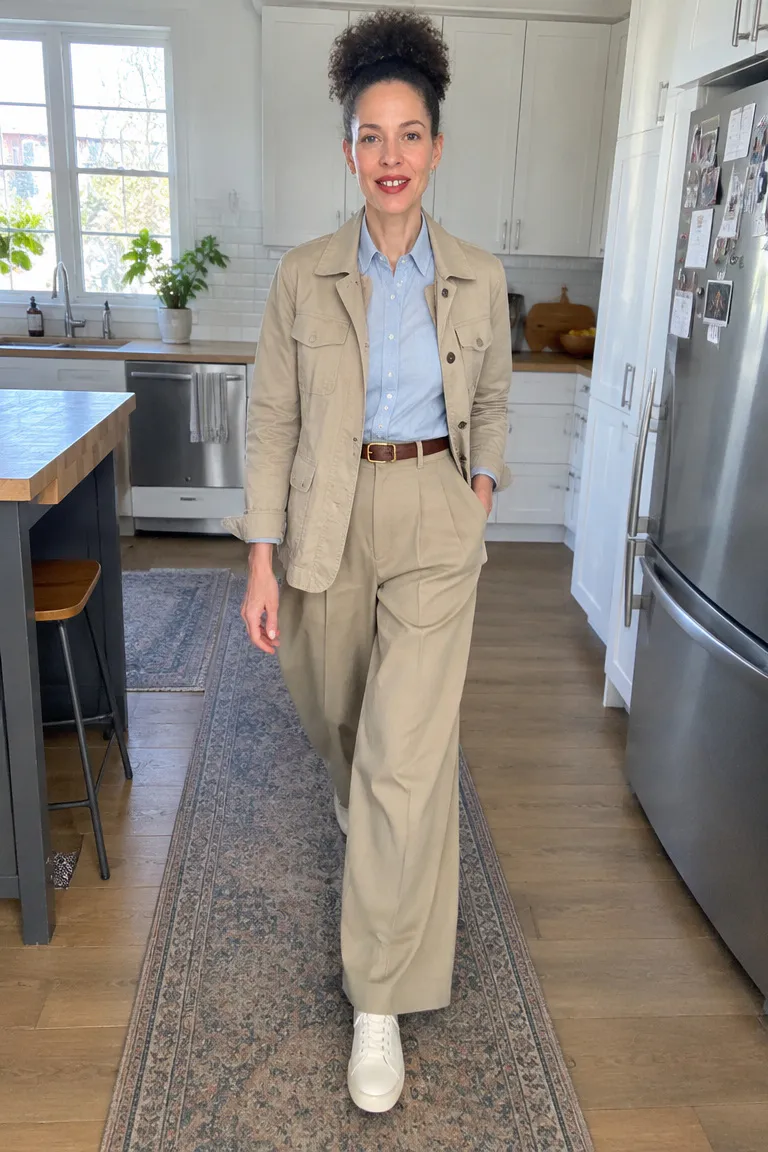
- Best for: Readers who worry khaki looks flat or sleepy, and who want a color that isn’t white.
- Wear it with: A pale blue oxford or poplin shirt, a mid-brown belt, clean low-profile cream sneakers, and a sand or khaki jacket one shade off from the trousers.
- Fit check: Wide hems swallow thin shoes. Choose sneakers with some sole width, and let the hem reach the top of the shoe without piling on the laces. Make the jacket and trousers visibly different shades so the set doesn’t read as a work uniform.
- Weather swap: For a warmer day, swap the jacket for the shirt alone with the sleeves rolled. If the office air conditioning runs cold, tie the jacket around your bag strap instead of leaving it behind.
Khaki is a warm, earthy color, so it looks flat when everything near it is warm too. Powder blue is cool and light, which gives the eye something to land on without the contrast of black or the starkness of white.
The brown belt matters more than it seems. It links the blue shirt back to the khaki, so the blue reads as a deliberate accent and not a stray piece from another outfit.
Wide-leg pleats carry a lot of fabric, which suits a shirt tucked in and a jacket kept open. Cream sneakers repeat the light tone of the shirt near the floor. If the outfit still looks sleepy, switch to a slightly deeper blue before changing anything else.
3. Black Knit Contrast
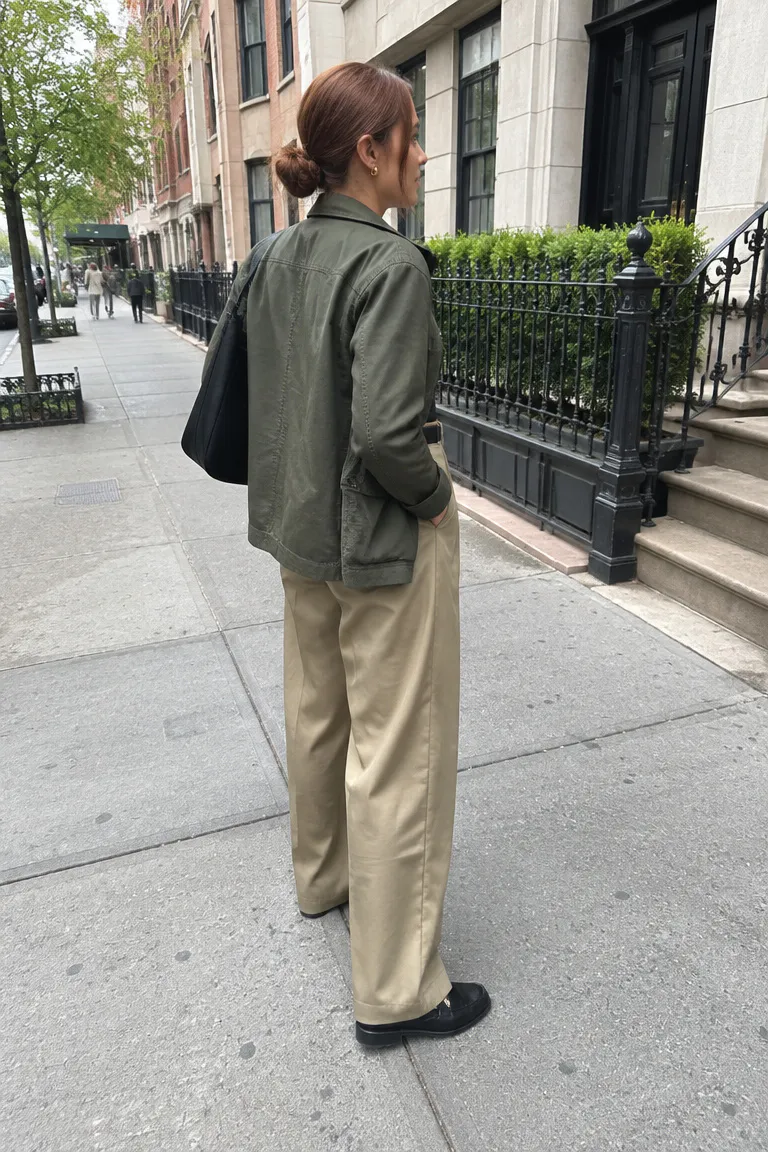
- Best for: Readers who find khaki dulling near the face, and anyone who wants a sharper look for a casual office day.
- Wear it with: A black fine-gauge knit or ribbed long-sleeve tee, a black belt at the natural waist, black loafers, and a dark olive jacket in a matte cotton.
- Fit check: Fully tuck a slim ribbed knit into straight or slightly relaxed pleats, and add a belt. With very full trousers, tuck only the front. A fitted top tucked into big volume without a belt makes the waist look lost.
- Weather swap: Black knits can feel heavy on a warm day, so go for a thin cotton tee in the same black. If the day turns cool, close the jacket and leave the knit as the base layer.
If khaki turns your face dull, put something dark between the trousers and your collarbone. A black fitted knit gives soft khaki a defined edge and takes over the job a white shirt would do, only sharper.
A dark olive jacket in matte cotton keeps the outfit tonal without competing with the knit. Black loafers repeat the top, so the khaki sits between two dark anchors.
- Slim or straight pleats: tuck the knit fully and add a black belt.
- Full or relaxed pleats: tuck only the front, so the knit doesn’t bunch at the sides.
- No belt: leave the knit untucked and let the jacket hem fall at the hip.
The belt is what keeps a fitted top and a lot of trouser volume from reading as one tube.
4. Tone-on-Tone Texture
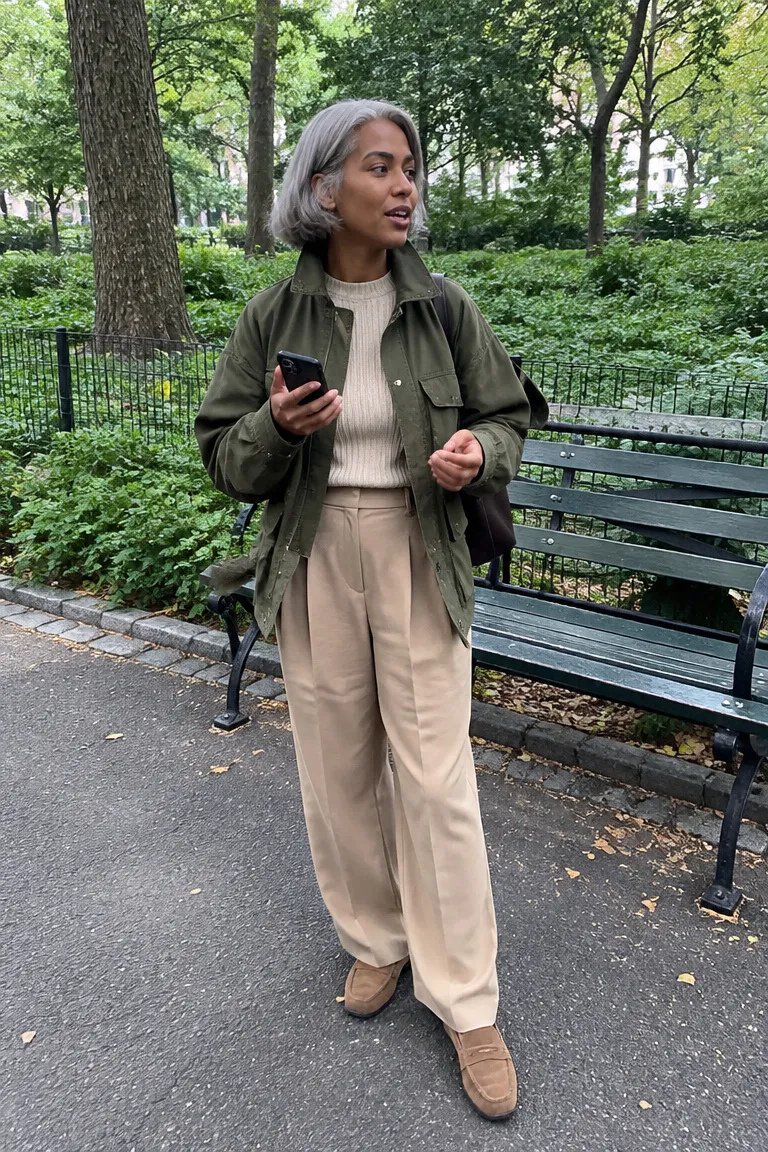
- Best for: Readers who love an all-neutral closet and worry about the outfit fading into beige.
- Wear it with: A chunky or ribbed oatmeal knit, sand trousers in a smooth twill, a mossy olive jacket, and tan suede loafers or low-profile sneakers.
- Fit check: Hold the three main pieces up in daylight before buying. If the jacket and trousers match almost exactly, change one of them toward olive or cream. Keep the knit slim enough to sit under the jacket without bulking the hips.
- Weather swap: On a mild day, replace the knit with a cream linen-blend shirt, then steam it first because linen blends crease fast. On a cool morning, keep the knit and wear the jacket zipped.
An all-neutral outfit works when each piece has a different surface and one piece sits off-center in color. Here, the smooth sand twill trousers meet a ribbed oatmeal knit and a matte jacket in mossy olive. Tan suede shoes finish it with a soft, napped texture.
- Trousers: sand, in a smooth twill with a little weight.
- Knit: oatmeal, chunky or ribbed, slim through the body.
- Jacket: mossy olive, noticeably greener than the trousers.
- Shoes: tan suede loafers or low-profile sneakers.
If the jacket and trousers could pass for a set, move one of them toward olive or cream. Buying a jacket that is clearly green is easier than hunting for a khaki that sits one precise shade away from your trousers.
5. Striped Tee and Tapered Pleats
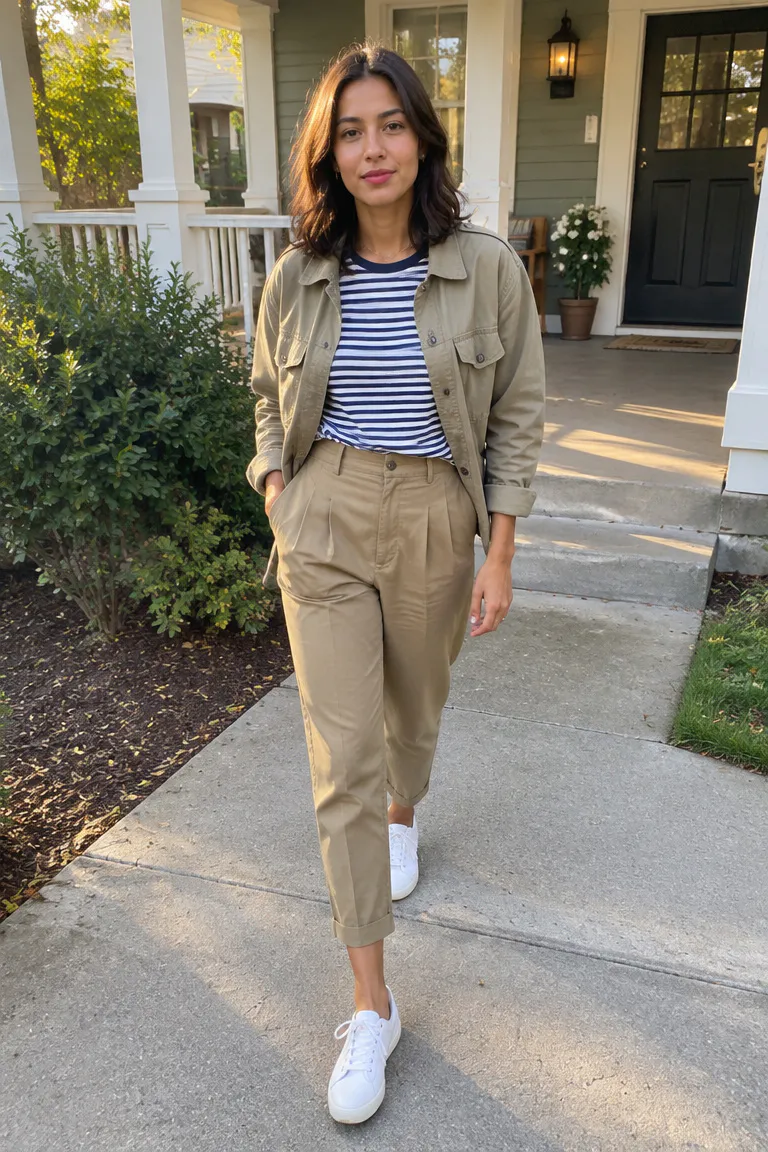
- Best for: Weekend walks, farmers markets and coffee stops where comfort leads.
- Wear it with: A breathable striped cotton tee, slim white or cream leather sneakers, a canvas tote, and a field jacket in a light khaki.
- Fit check: Check the ankle in the mirror. The hem should skim the top of the sneaker or sit just above it, not stack in folds. A tailor can hem the length and add a subtle taper while keeping the pleat placement. Tuck the front of the tee only.
- Weather swap: On a warm afternoon, drop the jacket and cuff the hem once above the ankle bone. On a cooler morning, add a thin crewneck under the tee.
Tapered pleats look best when the hem ends where the sneaker begins. The narrower leg makes extra length obvious, and fabric stacked at the ankle looks like a mistake.
A striped cotton tee breaks up the khaki without adding bulk. Tuck the front only, and the tee stays relaxed over the pleats while your waist still shows.
Over-the-shoulder is the lightest way to carry the field jacket, and it also keeps the stripes visible. On days when even soft pleats feel too structured for a long walk, these casual black leggings outfits for everyday wear give you a looser alternative with the same sneakers.
6. Petite Cropped Field Jacket
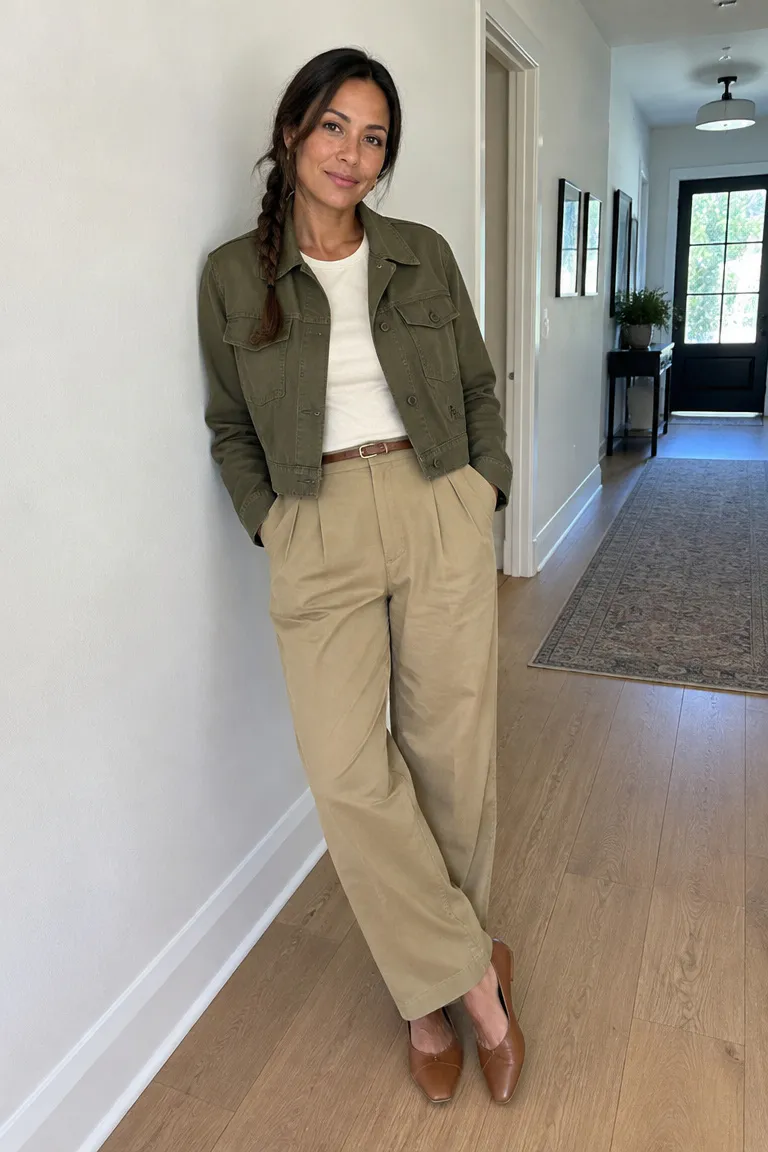
- Best for: Petite readers who lose their waist in long jackets, and anyone who wants a shorter layer.
- Wear it with: A slim cream or stone tee, high-waisted khaki pleats in a soft pleat, a thin belt, pointed or almond-toe flats or low loafers, and a cropped olive jacket.
- Fit check: The jacket hem should land at or above the widest part of the hip. Shoulder seams should sit at the shoulder bone, not past it. Pick a shallow or soft pleat, because deep pleats add volume at the hip.
- Weather swap: On a mild afternoon, push the sleeves up and leave the jacket open. In a cold office, button the jacket and keep the tee in a color close to the trousers.
On a shorter frame, a jacket that ends at mid-thigh cuts the leg line in half. A hip-length jacket keeps the legs long, and high-waisted pleats at the natural waist add to that line.
Pleated trousers already add volume at the hip, so a boxy jacket on top can look like a stack of fabric. A soft or shallow pleat helps, and so does a jacket that narrows at the hem.
A cream tee close to the stone of the trousers, finished with almond-toe flats in tan, avoids a horizontal break at the waist. Your eye reads one long column, and the olive jacket frames it.
7. Burgundy Top Color Pop
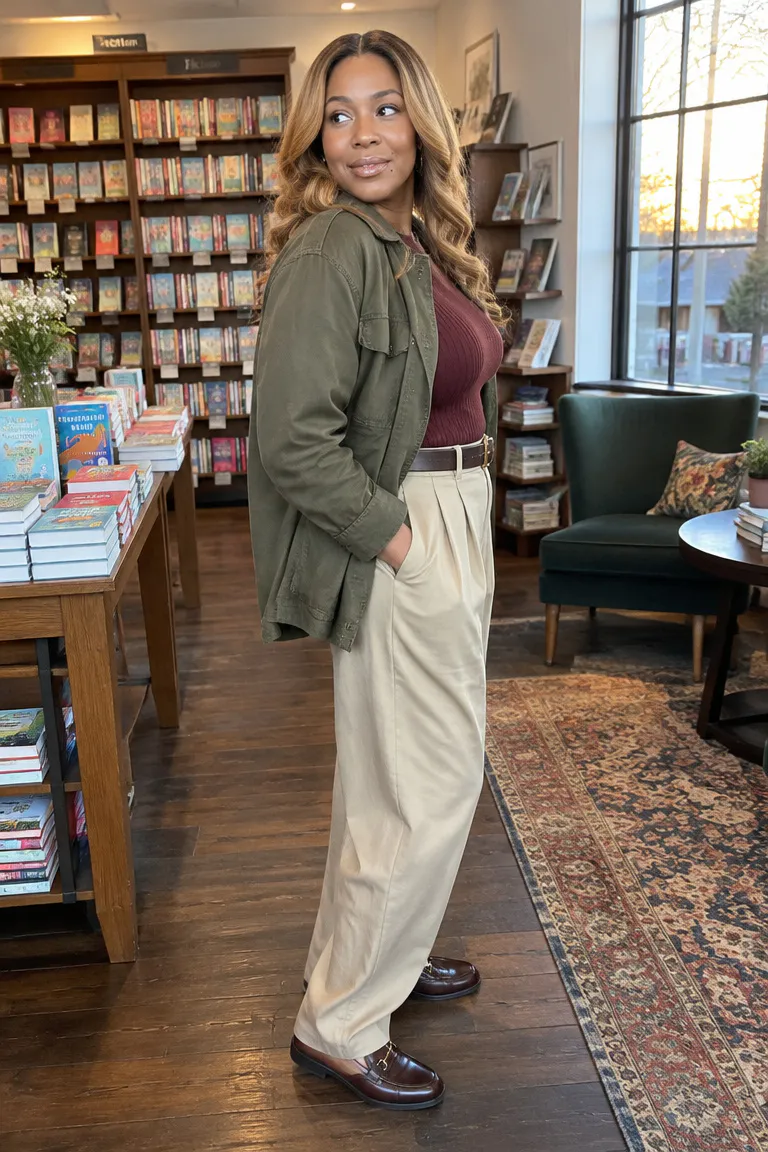
- Best for: Readers who want a spring color without leaving the neutral base, and anyone who owns one red or burgundy top.
- Wear it with: A burgundy knit or ribbed tee, khaki trousers in a warm stone, chocolate or cognac loafers, and an olive jacket worn open.
- Fit check: Choose a top in a matte knit so the color doesn’t fight the jacket texture. A red-brown belt and shoes in the same brown family make the outfit look planned. A black shoe is sharper but breaks the warm link.
- Weather swap: In warm weather, use a thin burgundy cotton tee and carry the jacket. If the day starts cool, layer a thin white tee under the burgundy knit instead of adding a second sweater.
Burgundy works with khaki because both share a warm, earthy base. Brown leather shoes, which carry a red undertone, connect the top to the trousers so the color feels placed on purpose.
Choose the top in a matte knit. A shiny or very thin fabric competes with the cotton texture of an olive jacket.
Which brown to buy: Chocolate and cognac loafers both link burgundy to khaki. A pale tan shoe is too close to the trousers to do the job, and black breaks the warm connection, so pick a brown with some red in it.
8. Open Jacket Over Ribbed Tank
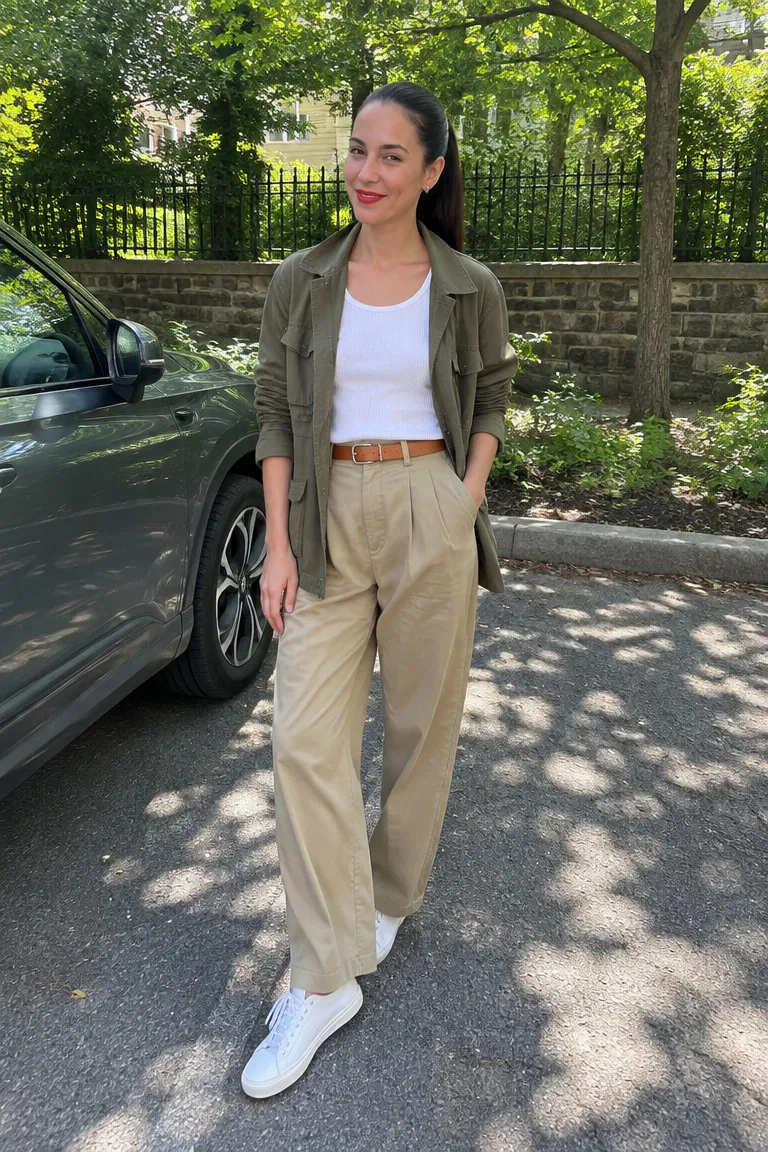
- Best for: A mild afternoon, a long day outside, or an office that runs warm in the afternoon and cool in the morning.
- Wear it with: A fitted ribbed cotton tank in white or black, a belt at the natural waist, khaki pleats, and a thin-soled leather sneaker. Skip delicate straps with a wide hem.
- Fit check: Put on the jacket over a thin sweater to test room. If it only fits over the tank, you lose the layering flexibility. A full tuck works with a fitted tank, but add the belt so the waist stays defined.
- Weather swap: On a cool morning, add a thin cardigan under the open jacket. On a warm afternoon, take off the jacket and wear the tank and belt on their own.
Spring seasons are short, so a heavily insulated jacket spends most of the year in the closet. A lightly lined or unlined utility jacket covers the cool mornings and mild afternoons that actually happen, and it can fold over a bag when the day warms up.
Room matters more than thickness. A jacket that fits only over a tank leaves you nowhere to go when the temperature drops, while one that clears a thin sweater gives you a second layer.
Wear it open, with the pockets visible. A fitted ribbed tank gives you a clean base, and a belt keeps the waist defined between the jacket fronts. Skip delicate straps with a wide hem, since the outfit reads better with a solid, plain shoulder.
9. Pale Pink and Army Green
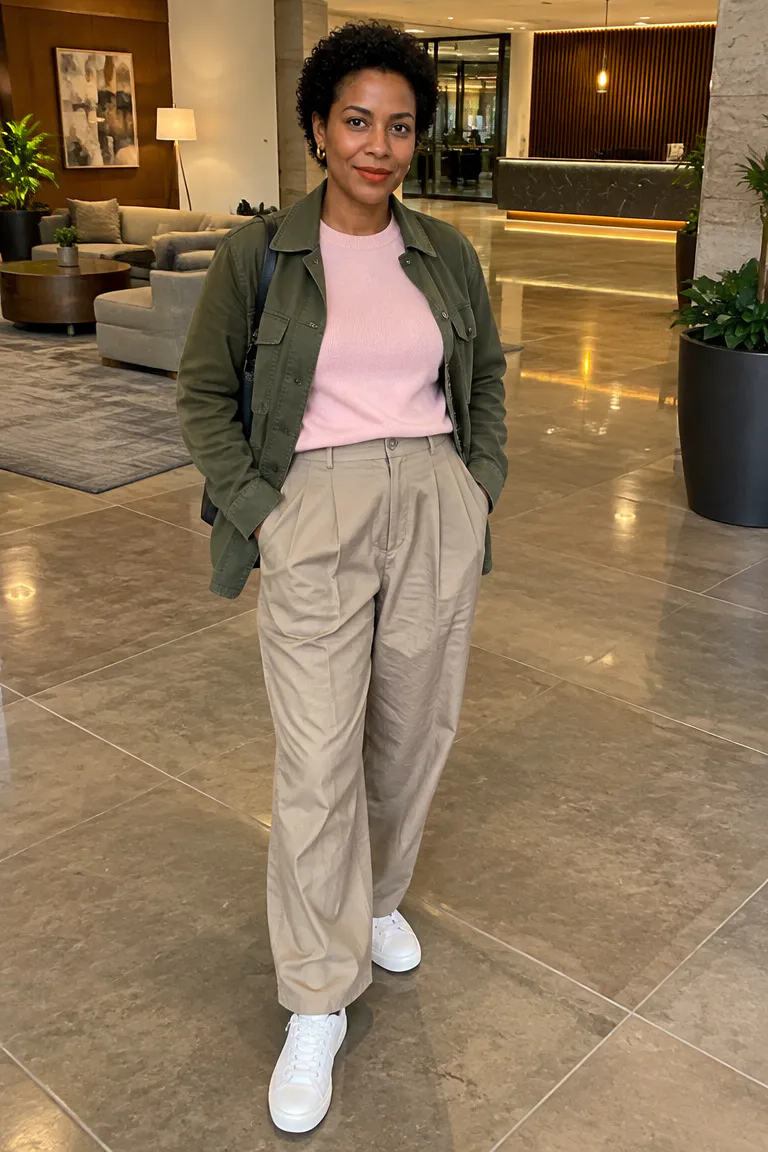
- Best for: Readers who want a softer spring look while staying with utility pieces.
- Wear it with: A pale pink crewneck or fine knit, an army-green field jacket in matte cotton, khaki trousers in stone, white sneakers or tan loafers.
- Fit check: Choose a pink with a little gray or cream in it, because bright pink competes with olive. Keep the knit slim so it doesn’t add bulk under the jacket, and tuck the front only.
- Weather swap: On a warmer day, use a thin pink cotton tee under the open jacket. On a cool morning, leave the knit on and wear the jacket zipped halfway.
Army green gives pale pink a counterweight, and pink softens a jacket with military edges. Together they look relaxed rather than sweet, and khaki fills in the space between.
Match the pink to your khaki. A stone or warm khaki goes best with a pink that has cream or a little peach in it, while a grayer khaki suits a dusty rose.
Avoid bright bubblegum pink, because it fights with olive and green. A slim fine knit, tucked at the front, keeps the jacket from feeling crowded, and white sneakers keep the shoe from adding another color.
10. Travel Day Pockets
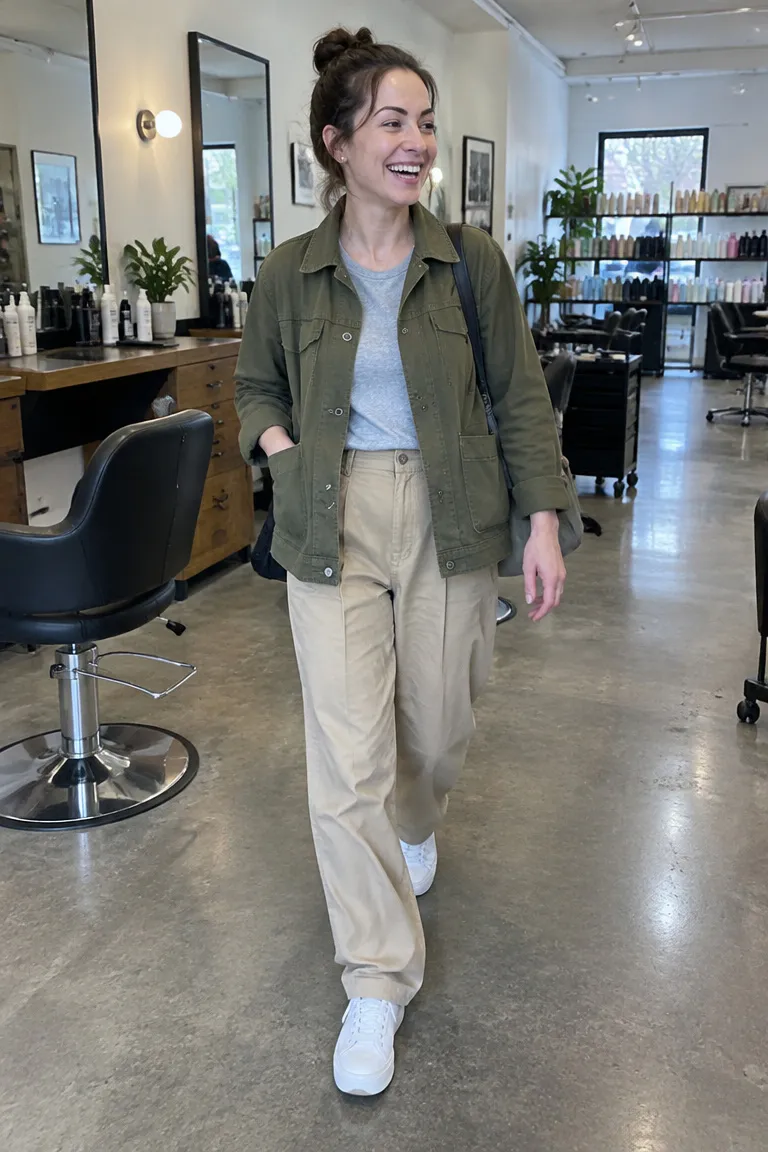
- Best for: Travel days, long walks and errands with several stops.
- Wear it with: A soft cotton tee, mid-rise khaki pleats with a little stretch or a relaxed seat, cushioned low-profile sneakers, and a roomy olive jacket with deep front pockets.
- Fit check: A mid rise is more comfortable if pressure at the upper stomach bothers you when seated. Sit down with your phone and keys in the pockets. If pleats pull open or pockets flare, size up or choose a softer pleat. Keep pocket contents slim so the jacket line stays clean.
- Weather swap: If the plane or train runs cold, wear the jacket with a thin sweater underneath. On a warm day, fold the jacket over your bag and keep the tee and trousers.
A field jacket with deep front pockets lets you keep a phone, keys and wallet close, so you aren’t digging through a bag at each stop. Pair it with a soft tee and mid-rise pleats, and the outfit stays comfortable through hours of walking and sitting.
A mid rise sits lower than a very high waist, which many people find easier when seated. Cushioned low-profile sneakers handle airport floors and city sidewalks without looking like gym shoes.
Pocket check: Load the pockets, sit down and stand up. If the jacket drags or the pleats pull open, slim down what you carry or move up a size.
For flights beyond a simple day trip, these airport outfits built for long flights add more layering and footwear options.
11. Navy Layer Office Look
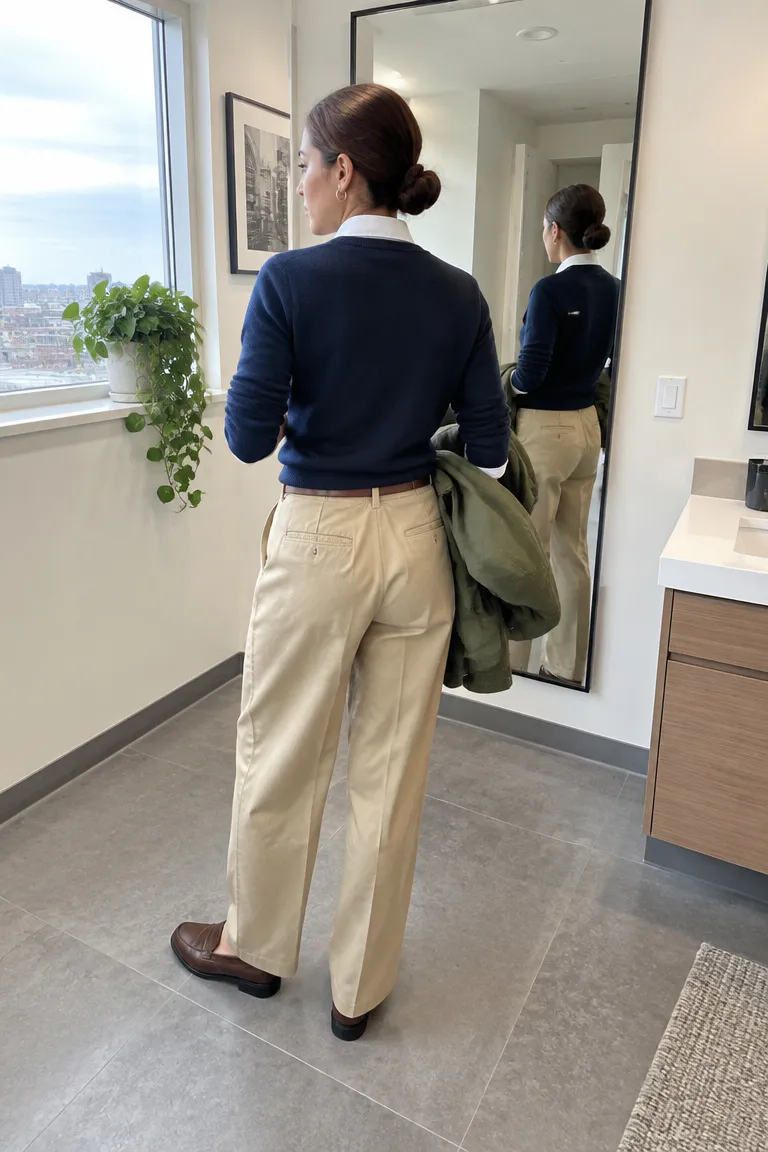
- Best for: Casual offices and commutes, especially where a blazer feels too formal for the walk in.
- Wear it with: A navy fine-gauge sweater or tailored navy shell, a crisp white collar underneath, khaki pleats in a smooth twill, leather loafers or a low block heel, and a field jacket for the commute.
- Fit check: Ask a tailor to adjust the waist, seat and hem so the pleats hang cleanly. Match shoe formality to the trouser: leather loafers or low heels suit structured pleats. Hang the field jacket at your desk and let the navy layer carry the office look.
- Weather swap: On a warm commute, carry the jacket and wear the navy layer alone. If the office is cold, wear the jacket at your desk over the knit.
A field jacket isn’t a blazer, so don’t ask it to be one. Treat it as the commute layer, and let the navy knit and white collar underneath carry the office look once the jacket comes off.
Casual cotton outerwear looks polished when everything under it is crisp. A smooth twill trouser, a fine-gauge sweater and a collar peeking out say planned, and loafers or a low block heel match the formality of the pleats.
- Hang the jacket at your desk, not on the back of your chair.
- Press the collar and trouser creases before you leave.
- Keep the belt and shoes in the same dark brown.
A tailor can fix the waist, seat and hem of a pair you already own. That usually matters more than buying a more expensive pair.
12. Black Pleats With Khaki Accent
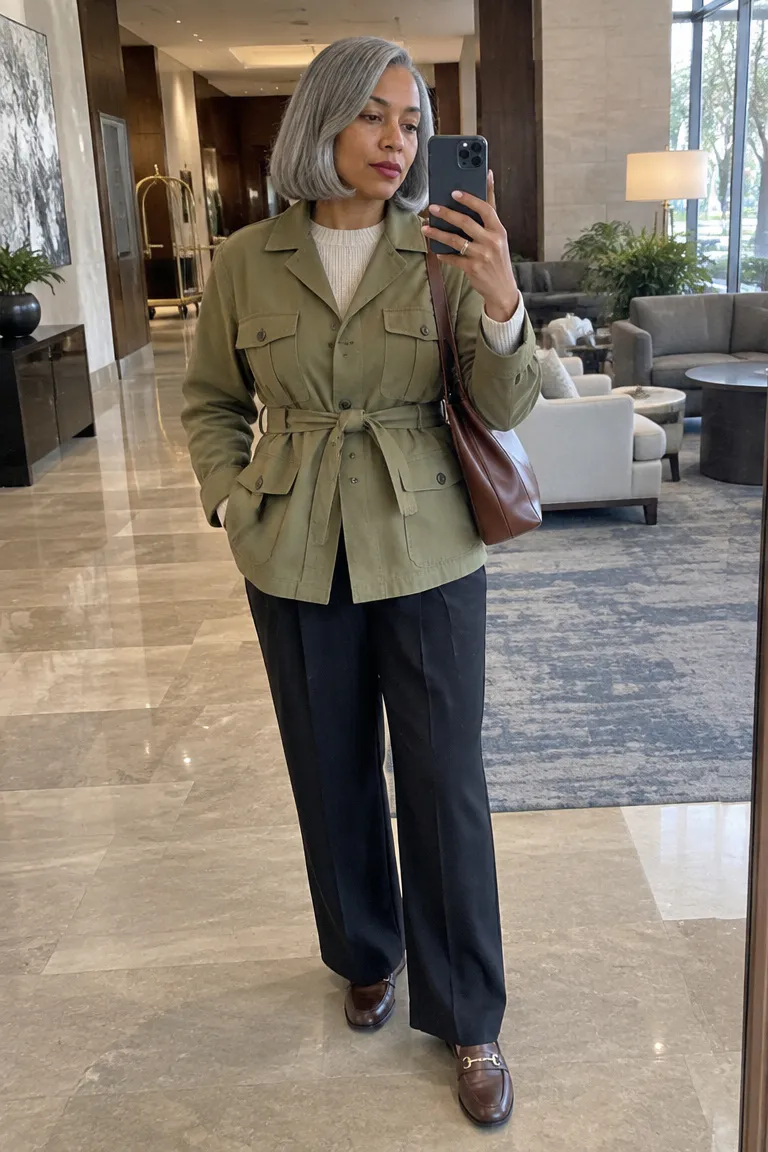
- Best for: Readers who wear black trousers most and want a spring layer that isn’t black.
- Wear it with: A khaki or stone knit, black pleated trousers in a matte fabric, a belted khaki utility jacket, and brown loafers instead of black shoes.
- Fit check: Tie the jacket belt at the natural waist so the black pleats don’t add width at the hip. Keep the knit slim, and make sure the hem of the black trousers reaches the top of the loafer. Check that black pleats stay closed when you sit.
- Weather swap: On a warm afternoon, open the jacket and tie the belt behind you, or carry it. On a cool morning, wear it belted over the knit and keep the loafers.
If black trousers are what you actually wear, let khaki be the spring layer. A belted utility jacket in khaki sits against matte black pleats, and a stone knit in between brings the two colors together.
Tie the jacket belt at your natural waist. It pulls the jacket in and keeps black pleats from adding width at the hip.
Brown loafers soften the black and tie back to the khaki, where black shoes would make the whole outfit look heavier. Choose matte black fabric, because a sheen shows every crease from sitting and clashes with cotton.
Where to Spend First
Spend first on the pleated trousers, and have the waist and hem tailored to the shoe you wear most. Add a lightly lined olive or khaki field jacket next, then brown loafers and clean low-profile sneakers. Together those pieces cover nearly every outfit here, and a white poplin shirt and one dark knit will carry them through a week of travel.