16 Poetcore Winter Outfits for Women With Turtlenecks, Vintage Blazers, and Capes
A turtleneck and a thrifted blazer can read as poetcore or as a costume, and the difference usually comes down to shoulder fit and hem length, not the pieces themselves. Check the blazer’s shoulder seam first. It should sit at the edge of your shoulder with room to bend your arms over a knit.
If it does, nearly everything else can be fixed with a tailor, a cuff, or a different hem.
The sixteen outfits below start with a five-piece kit and branch into five kinds of cape, from a sleeveless wool cape to a velvet one. Each entry tells you what to pair, where the fit tends to go wrong, and what to change when it rains or the room runs hot. There’s also a pass-or-fail check for thrift racks, so you can decide in the aisle.
1. Cream Turtleneck, Herringbone Blazer, Wide Trousers
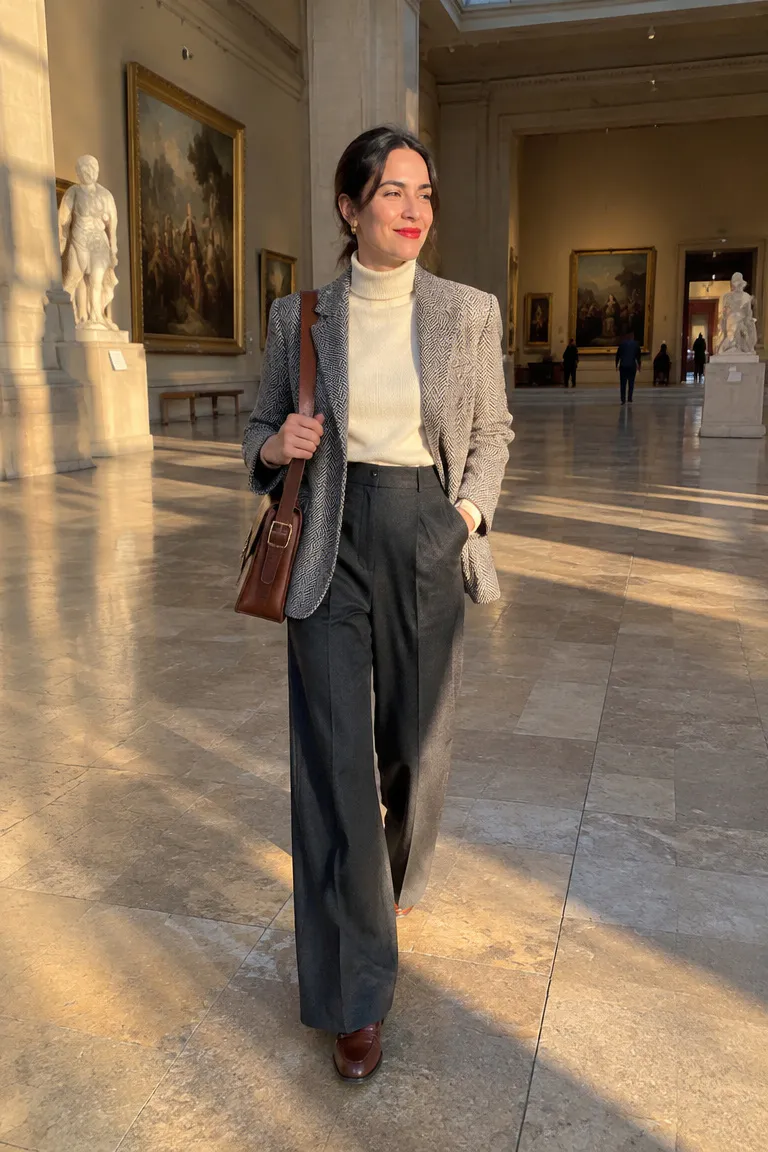
- Best for: A first poetcore outfit from closet staples, or an optional fit for class, a bookstore run, or a coffee stop
- Wear it with: Brown leather loafers, a worn leather satchel, small pearl studs, and a loosely knotted thin scarf
- Fit check: The blazer shoulder seam should sit at the edge of your shoulder, with room to bend your arms over a turtleneck without the back pulling. Sleeves should end near the wrist bone. Trouser hems should graze the top of the shoe and clear wet pavement.
- Weather swap: On a wet day, hem the trousers a half inch shorter or cuff them once, and carry an umbrella, since wool only sheds light moisture. Indoors, the blazer comes off and the turtleneck stands on its own.
Most of the looks in this list come from five pieces, and this outfit uses three of them to show why they hold together. Herringbone gives the blazer texture without a loud pattern, so it sits quietly next to a cream knit.
Proportion matters more than any single piece. A thin turtleneck and a blazer with natural shoulders keep the top half narrow, which lets a wide wool leg hang straight without swamping you. Put a boxy blazer over wide trousers and the waist disappears.
- Turtleneck: fine knit in cream, black, or oatmeal
- Blazer: tweed, herringbone, or flannel in a muted tone
- Cape or cape-style coat: camel, charcoal, or oatmeal
- Trousers: wool, straight or wide, in charcoal or brown
- Shoes: loafers with a real sole, or oxfords
2. Tartan Pleats, Tweed Blazer, Oxfords
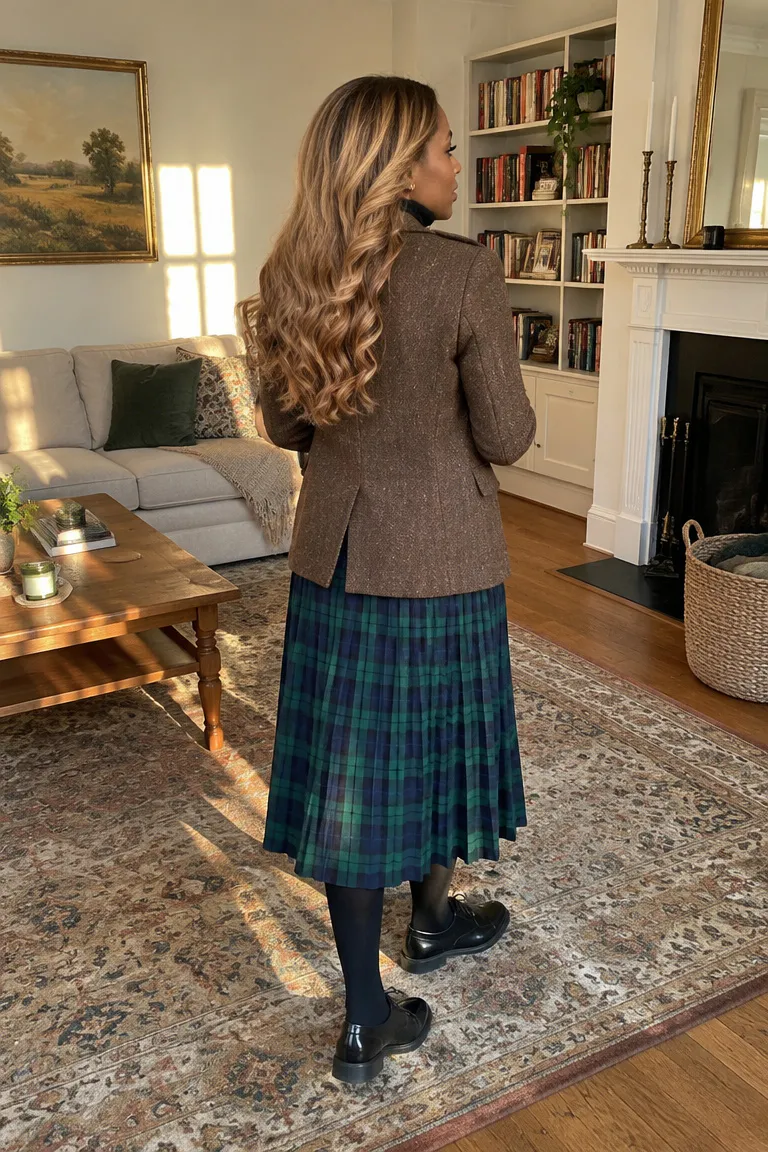
- Best for: Long walking days, campus-style outfits, or a gallery or reading as an optional fit
- Wear it with: A thin black turtleneck bodysuit for a smooth line, opaque wool-blend tights, black or brown oxfords, and a narrow ribbon at the collar
- Fit check: A turtleneck bodysuit keeps the tuck flat under a skirt waistband. If you wear a regular turtleneck, tuck it before the blazer goes on. Let the skirt hem land at mid-calf so it doesn’t collide with boot or oxford tops.
- Weather swap: For wet pavement, switch to tights with a little more weight and a leather oxford with a thicker sole. Wet wool hems dry slowly, so skip the longest skirt on rainy days.
Start at the ground. A pleated tartan midi can drag through slush, so the shoes and hem do the work here: oxfords with a real sole, opaque tights, and a hem that clears the ankle. Mid-calf is the safest length because it stays out of the way of boot tops if you change shoes.
Tweed’s rough texture sits well beside tartan as long as the colors stay in one family. Green and navy in the skirt will pick up a brown fleck in the jacket without matching it. Leave patterned tights out, since a third pattern is one too many.
What breaks it: A chunky logo sneaker flattens the whole outfit. The tartan and tweed already carry the visual weight, and a thick white sole chops the leg line. If you need comfort for a long walk, pick an oxford with a thicker rubber sole instead.
3. Sleeveless Wool Cape, Slim Trousers
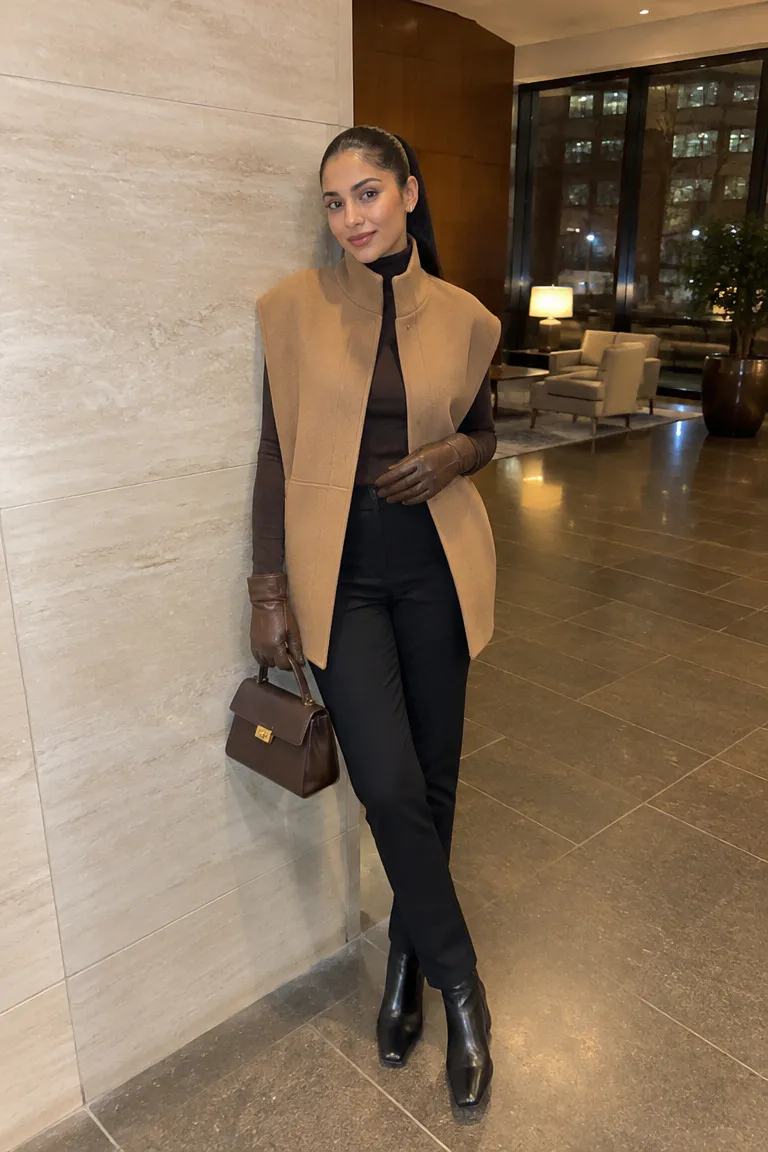
- Best for: Cold commutes and errands where you need free hands
- Wear it with: A fitted merino turtleneck, slim black wool trousers, ankle boots with a low heel, soft leather gloves, and a top-handle bag
- Fit check: The cape should end around the hip or just below it so it doesn’t swamp a slim leg. Raise your arms in a mirror and check that the front panels don’t ride up past your waist.
- Weather swap: In wind, pick a cape with a high collar or add a thin silk scarf tucked inside. If the day turns mild, drape the cape over your arm and the turtleneck outfit still reads finished.
A sleeveless wool cape leaves your arms free, so it suits desk work, driving, and carrying things better than a full cape coat. The trade-off is cooler arms. A fine merino turtleneck with full sleeves and soft gloves is the warmth plan, and the gloves should meet the knit cuff so no skin shows at the wrist.
Bags need a rule here. A shoulder bag slips off the cape and crushes the drape, so carry a top-handle bag or wear a crossbody underneath the cape.
The cape adds width on top, so keep the legs slim. A narrow black wool trouser and a low-heeled ankle boot hold the outline tidy.
4. Corduroy Blazer With Straight Jeans

- Best for: Weekend errands, thrift runs, and relaxed days with a lot of in-and-out of shops
- Wear it with: An oatmeal ribbed turtleneck, dark straight-leg jeans, brown leather boots with a flat sole, and a canvas or leather messenger bag
- Fit check: Check the corduroy at the elbows and shoulders for flattened or shiny patches, which show wear. Sleeve ends should hit the wrist bone, or you can push them up to the forearm if they run long.
- Weather swap: Corduroy takes water slowly and dries stiff, so a rainy day calls for a coat or cape on top. Indoors in warm rooms, drop the blazer and keep the turtleneck and jeans.
Corduroy is a softer, more casual blazer fabric than tweed, which is why it pairs with plain dark jeans instead of wool trousers. The wide ribs already add texture, so keep everything else solid: oatmeal on top, indigo below, brown leather underfoot.
If the blazer runs slightly big, a heavier ribbed turtleneck underneath fills out the chest and shoulders. Pushing the sleeves up to the forearm can also help the proportions. Treat both as styling fixes, because a blazer that’s truly wrong across the shoulders won’t be rescued by a thicker knit.
A flat-soled boot fits the day. You’ll be stepping in and out of shops, and corduroy’s casual weight looks better with a boot built for pavement than with a dressy heel.
5. Cape Coat, Wool Midi Skirt
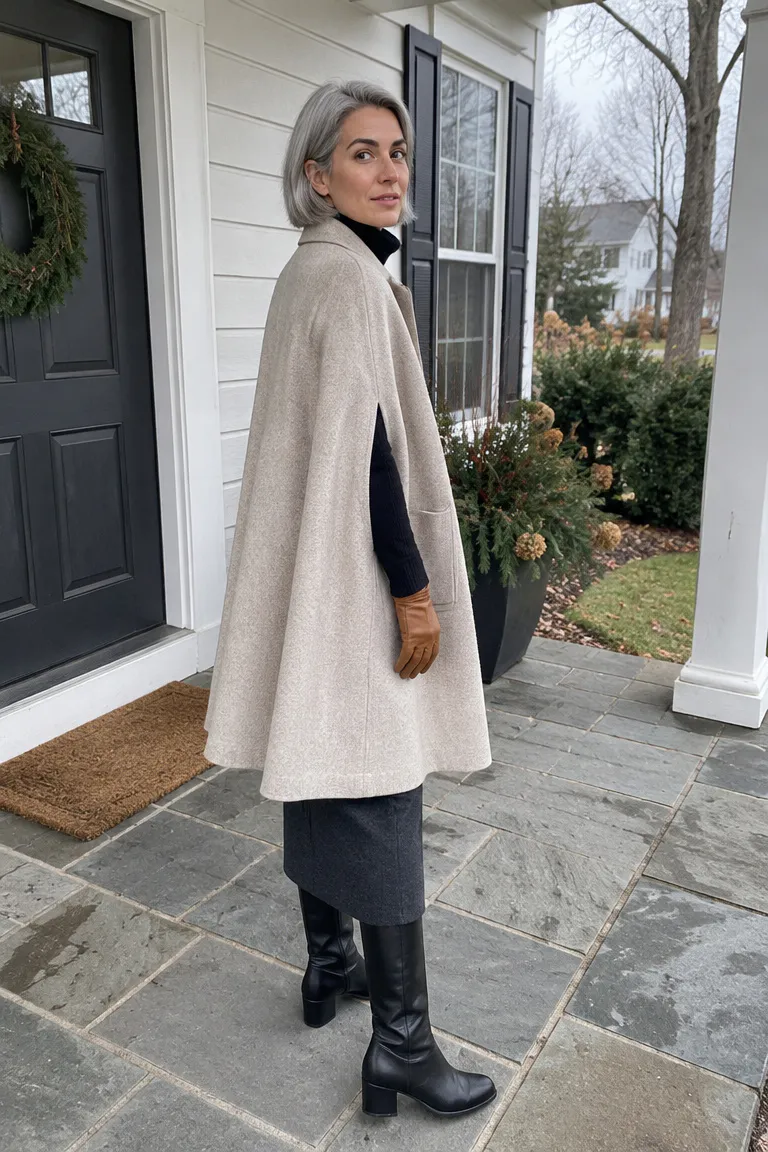
- Best for: Daily errands, commutes, or a dinner out as an optional fit
- Wear it with: A thin black turtleneck, a straight charcoal wool midi skirt, knee-high leather boots, and gloves that go inside the cape sleeves
- Fit check: Stand in front of a mirror and check the cape hem against your knee or mid-calf. Shorter or lighter capes suit smaller frames better, while long heavy ones can swamp them.
- Weather swap: If the skirt hem catches wet pavement, swap to boots with a taller shaft and tuck the skirt a touch shorter. On colder days, add a second pair of tights under the skirt rather than a bulky layer under the cape.
The cape coat with arm slits and front pockets is the most practical cape for daily errands. The slits let you reach for keys or a transit card without lifting the whole front, and the pockets solve the bag problem on short trips.
Because the cape adds volume on top, keep what’s underneath narrow: a thin turtleneck and a straight wool midi skirt. A full skirt under a full cape makes a bell shape.
The five capes in this list behave differently, so check the table before you buy one.
| Cape type | Arm access | Warmth | Where it fits |
|---|---|---|---|
| Sleeveless wool cape | Arms free, knit sleeves show | Warm torso, cooler arms | Desk work, driving |
| Cape coat with slits and pockets | Slits for hands | Warmest of the five | Daily errands, commutes |
| Hooded cape scarf | Open drape | Light, blocks some wind | Short outings, windy walks |
| Velvet cape | Open drape | Dressy, not a rain layer | Dinner, readings, galleries |
| Knit scarf-cape | Open drape | Breathable, light | Shorter frames, casual days |
6. Olive Velvet Blazer, Satin Skirt
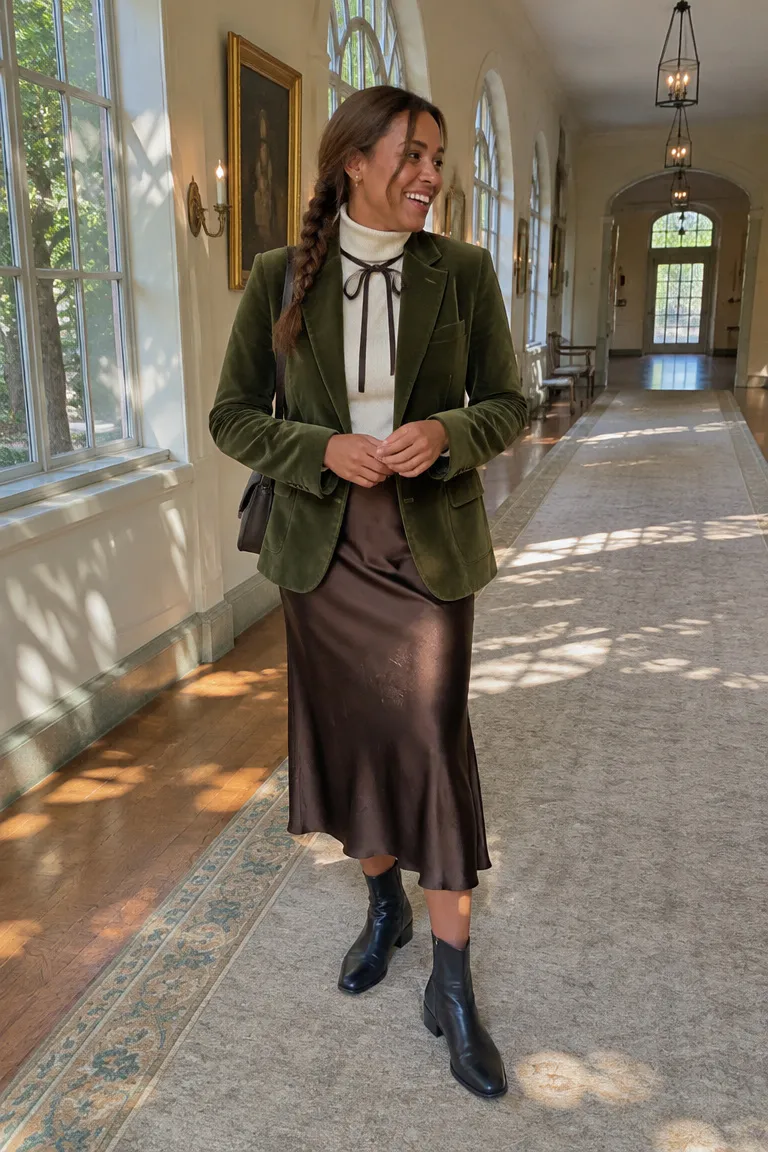
- Best for: Dinner or a reading as an optional fit; any night when you want soft texture over a plain base
- Wear it with: A cream turtleneck, a dark brown satin slip skirt, low-heeled ankle boots, a thin velvet ribbon, and small pearl studs
- Fit check: Velvet adds visual weight, so confirm the blazer is not tight across the upper back or the pile will pull. The slip skirt should skim the hip without clinging, with a hem near mid-calf.
- Weather swap: Satin skirts feel cold against bare legs, so wear sheer or opaque tights under them. For rain, velvet marks easily, so use a cape or coat on top and an umbrella.
Velvet over a satin slip skirt turns a plain cream turtleneck into evening wear without changing the base. The matte pile absorbs light while the satin reflects it, and that contrast does the dressing up.
A narrow ribbon or tie at the collar keeps it poetcore instead of party wear. It’s a small, slightly old-fashioned detail that makes the neckline look chosen. Low-heeled ankle boots finish the outfit, while a stiletto would push it toward cocktail.
For a December party, the same rule of one festive piece on a plain base runs through Christmas party outfits that aren’t over the top, with notes on shoes and the walk in from the car.
7. Chunky Turtleneck, Roomy Plaid Blazer
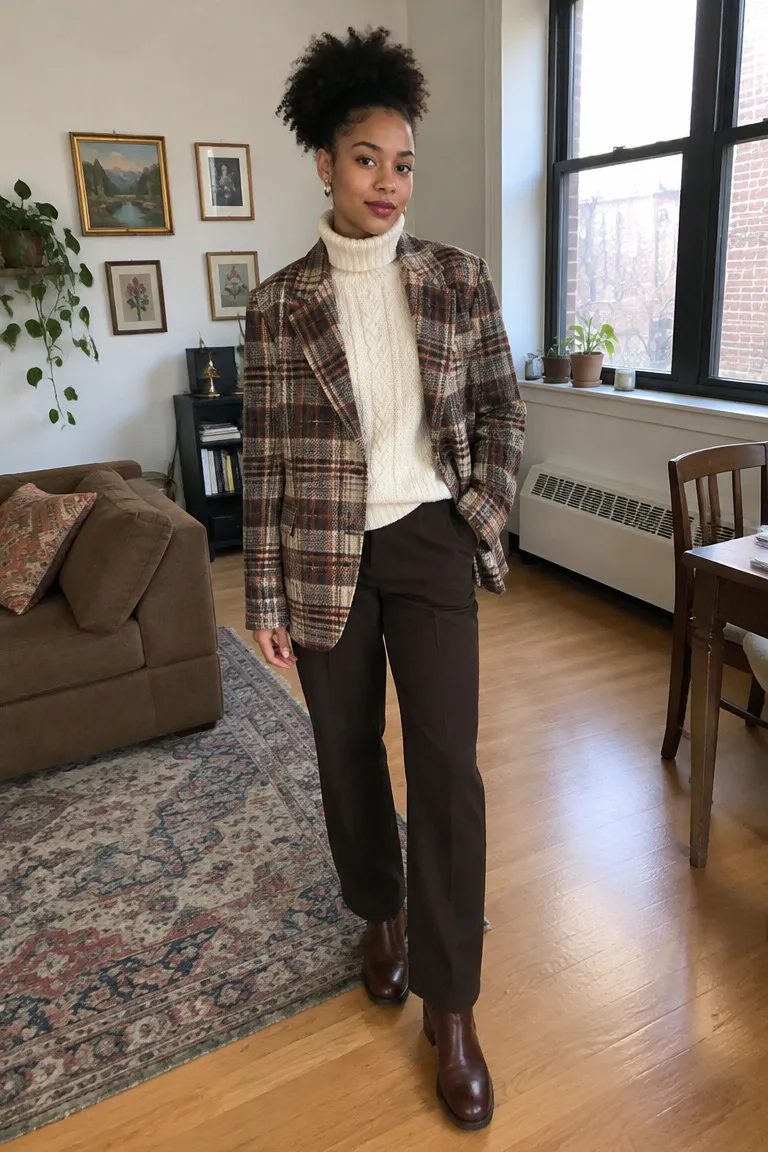
- Best for: Cold days when you want the bulk of a sweater and the structure of a blazer
- Wear it with: A cable-knit turtleneck in cream or oatmeal, a brown-and-rust plaid blazer, straight dark trousers, and sturdy leather ankle boots
- Fit check: Put the turtleneck on first before trying any blazer. Raise your arms and reach forward. If the back seam strains or sleeves ride up past the wrist, go up a size or switch to a fine knit.
- Weather swap: This stack is warm indoors, so for mild days swap to a thin cotton rib turtleneck. If you wear it outside, a cape goes over it better than a sleeved coat that would bunch.
Chunky knits need a blazer cut roomier through the shoulders and arms, or the sleeves bind and the back pulls. "Oversized" still has to fit across the shoulder seam, with the extra room in the body and sleeves instead of a seam that droops down your arm.
A brown-and-rust plaid works with a cream cable knit because the colors are warm and low in contrast. The plaid carries the pattern, the knit carries the texture, and the trousers stay plain.
If the blazer feels snug over the knit, don’t force it. Move the chunky turtleneck under a cape, where it has room, and wear the blazer with a fine knit on another day.
8. Hooded Cape Scarf, Wide-Leg Jeans
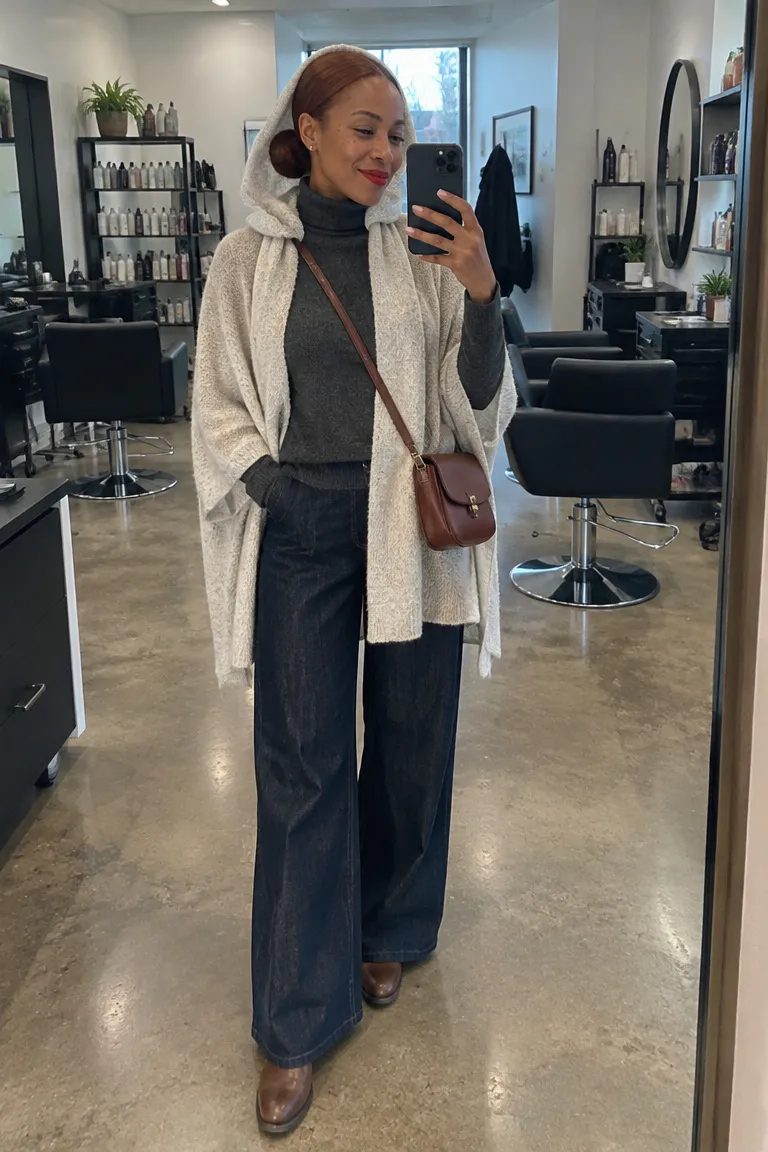
- Best for: Windy walks, short outings, and days that swing between outdoors and heated rooms
- Wear it with: A charcoal turtleneck, wide-leg dark jeans, flat leather boots, and a crossbody bag worn under the cape
- Fit check: The cape should drape over the shoulders without sliding off when you move your arms. Wide jeans should cover the boot top without puddling on the ground.
- Weather swap: A knit cape isn’t rain protection, so for wet weather use a coat with the cape as a scarf layer inside. If the room is warm, fold the cape over a chair and the turtleneck outfit still holds up.
Wind at the neck is what makes a hooded cape scarf useful. It’s the lightest cape in this list, built as a wrap-and-go layer instead of full coverage. Indoors the hood stays down and the cape sits like an oversized scarf, and outdoors it covers your ears.
Let the hood be the statement. A charcoal turtleneck, dark wide-leg jeans, and flat boots give it a quiet background, and a crossbody bag worn underneath keeps the drape from sliding.
For a trip somewhere truly wet and windy, Scotland Highlands outfits for misty, cold days are built for roughly October through March.
9. Turtleneck Dress Under Vintage Blazer
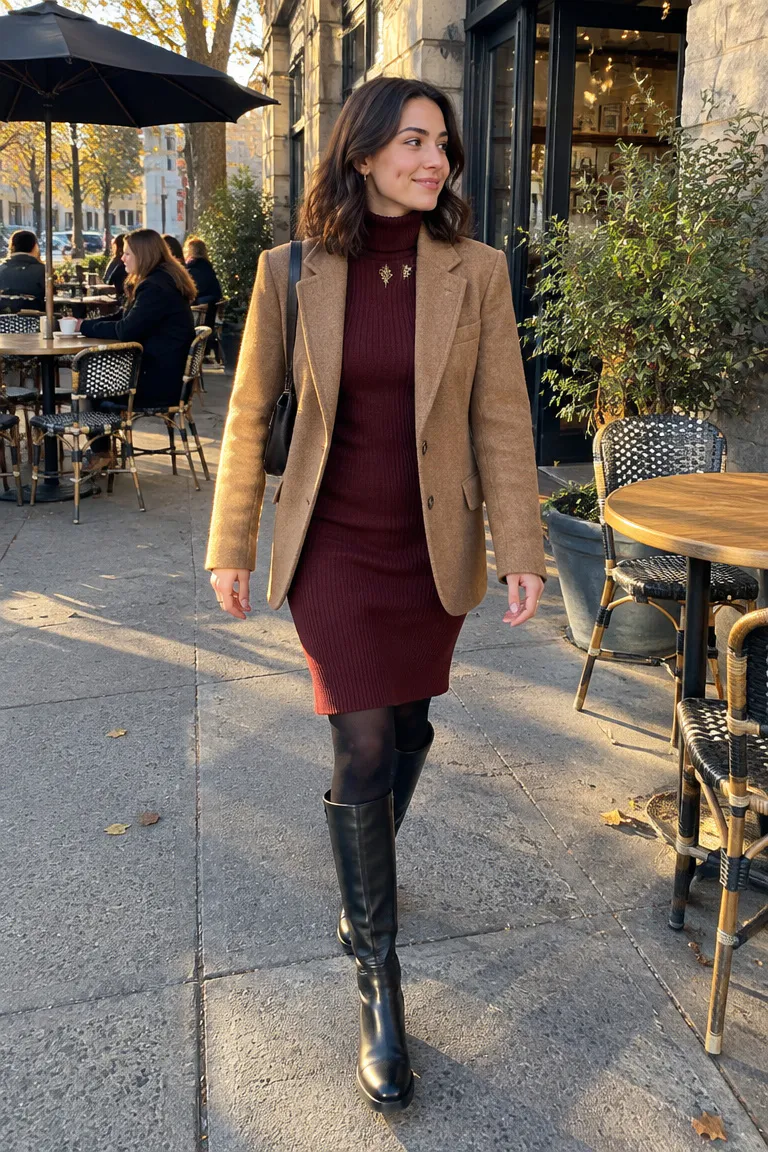
- Best for: Quick dressing for a gallery, class, or dinner as an optional fit
- Wear it with: Opaque tights, knee-high or ankle boots, a brooch off-center on the collar, and a structured top-handle bag
- Fit check: Check that the dress doesn’t cling at the hip under a blazer. Hem length should land at the knee or lower so the blazer hem and dress hem don’t compete.
- Weather swap: Wool dresses can itch against bare skin, so wear a thin cotton layer underneath or test it on your neck before buying. In heated rooms, slip the blazer off and let the dress stand alone.
A knit turtleneck dress under a blazer removes the top-and-bottom matching question. One base piece, one pair of tights, and you’re dressed.
Proportion decides which blazer to use. A fitted dress works with a blazer that has soft or modest shoulders, while a boxier vintage blazer needs a slimmer dress under it so the shape doesn’t balloon.
Keep the hem at the knee or lower so the dress and blazer hems don’t compete. A brooch off-center on the collar gives the plain knit one deliberate detail.
Belt placement: A thin leather belt works two ways. Under an open blazer, it defines the waist. Over a boxy blazer, it cinches the cut and keeps the lapels flat. Match the belt to your boots, brown with brown or black with black.
10. Flannel Blazer, Cuffed Trousers, Loafers
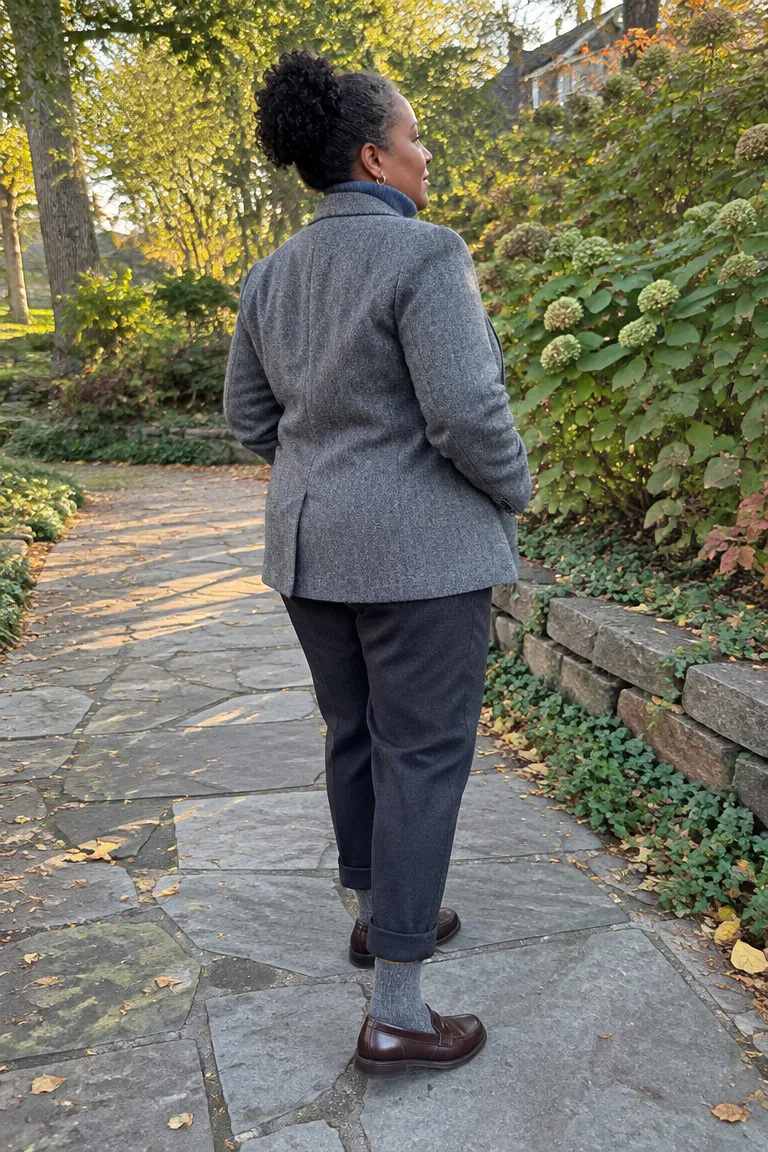
- Best for: Long days on your feet, office-adjacent settings, or bookstore trips as an optional fit
- Wear it with: A muted blue turtleneck, gray flannel blazer, tailored cuffed trousers, wool socks, brown loafers, and a leather belt
- Fit check: A cuffed hem should end just above the shoe so the sock peeks through. Check the blazer’s sleeve length in a bent-arm position so the cuff doesn’t ride up on the turtleneck.
- Weather swap: For wet pavement, use a loafer with a rubber or thicker sole and wear wool socks with a slightly higher cuff. If the day is mild, pick a lighter cotton turtleneck so the flannel doesn’t overheat you.
Soft-soled loafers make this the easiest outfit here to walk in all day. A cuffed trouser hem shows the ankle or sock line, which gives the shoe a clean outline and keeps the wool off wet pavement.
Flannel suits the look because it’s a brushed, heavier wool with a quiet texture. It doesn’t compete with a muted turtleneck, and gray against dusty blue reads calm instead of corporate.
A leather belt ties the trousers to the shoes. Match the leather tone to the loafers and the lower half looks planned.
11. Windowpane Blazer, Tights, Mini Skirt
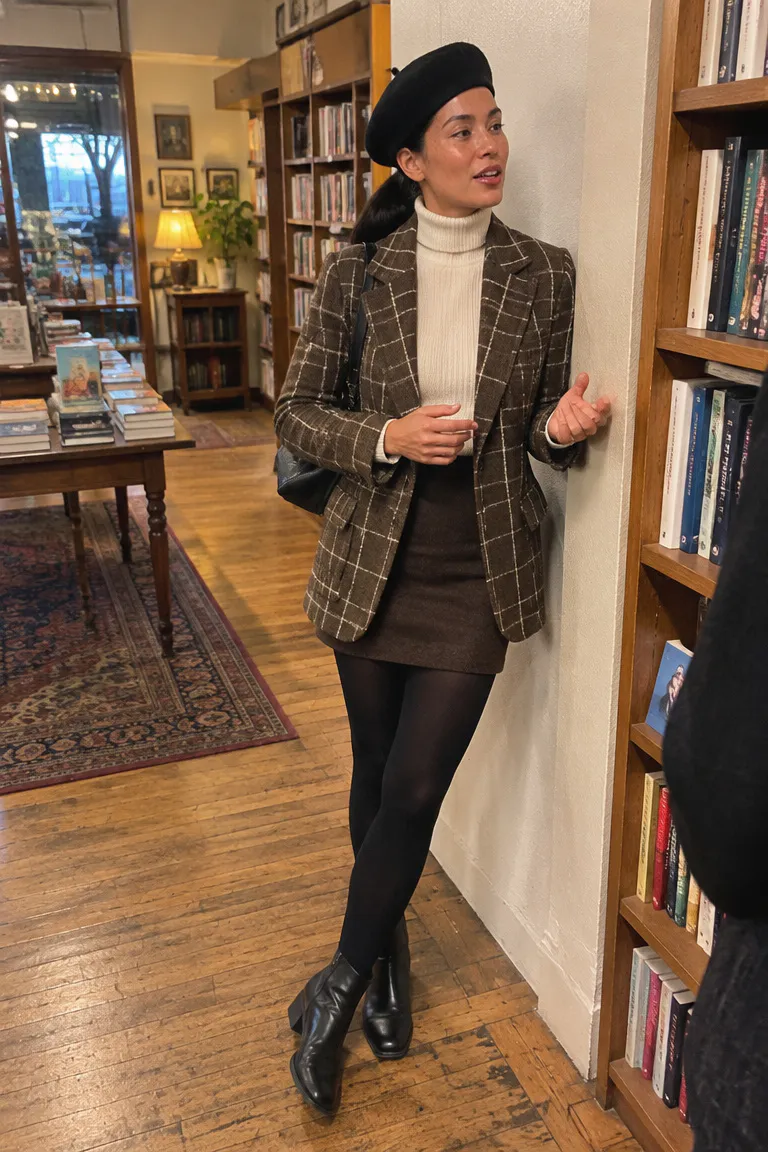
- Best for: Shorter outings, evenings, or reading and gallery visits as an optional fit
- Wear it with: A cream ribbed turtleneck, a solid dark brown wool mini skirt, thick opaque tights, ankle boots with a low heel, and a beret
- Fit check: The blazer hem should fall at or below the skirt hem so the legs don’t look cut off. Sit down in the mirror to check the skirt length, and confirm the tights don’t bag at the knee.
- Weather swap: For colder days, wear fleece-lined or heavy wool tights and a tall boot. For wet weather, skip suede ankle boots and use leather.
A mini skirt in winter depends on the tights and the boot, not on the skirt. The warmth plan has three parts:
- Tights: thick, opaque, and snug at the knee so they don’t bag
- Boots: ankle height with a low heel, in leather
- Blazer: long enough to land at or below the skirt hem
A windowpane check carries the pattern, so the skirt stays solid. Cream rib and a dark brown skirt give the check room to stand out, and a beret adds a finishing note without another layer.
The longer blazer also balances the short hem. It lengthens the torso and covers the top of the skirt line, so the legs don’t look cut off.
12. Burgundy Velvet Cape, Black Turtleneck
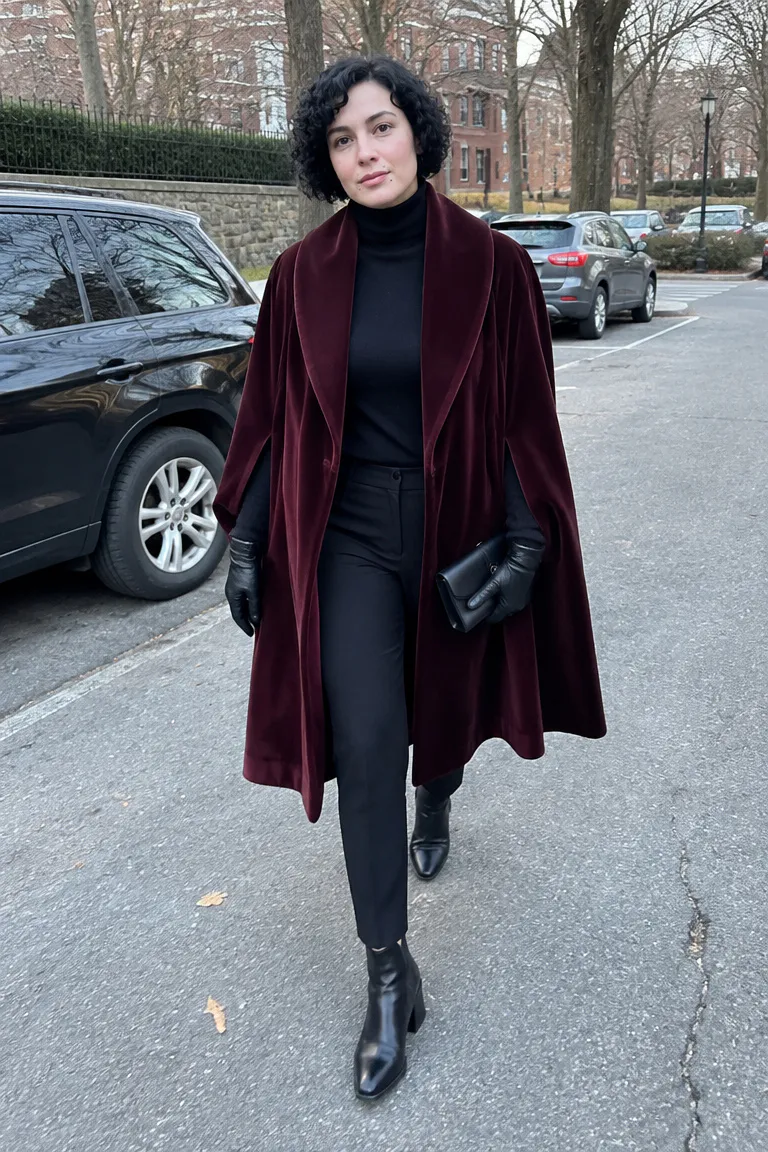
- Best for: A dinner, reading, or gallery as an optional fit, anywhere you want one statement layer
- Wear it with: A fitted black turtleneck, narrow black trousers, low-heeled boots, thin black gloves, and a small clutch
- Fit check: Velvet is heavy, so check that the cape’s weight doesn’t pull the neckline back while you walk. The hem should sit at or above mid-calf so the trousers and boots stay visible.
- Weather swap: Velvet isn’t a rain layer, so keep an umbrella ready or wear a coat for the commute and put the cape on once inside. For extra warmth, a thin merino turtleneck under the black one adds insulation without bulk.
A velvet cape is a dress-up layer, not an all-day coat. The arms stay cool, the pile marks easily, and the weight can tug at the neckline. Plan it for one evening, not a commute.
Keep the base plain so the cape does the work: a fitted black turtleneck, narrow black trousers, low-heeled boots. A clutch or top-handle bag beats a shoulder bag, which rubs the pile and can leave shiny patches.
If you want more of this mood, dark romantic Valentine’s date night outfits work burgundy, black, and plum with notes on fit, fabric, and warmth.
13. Knit Scarf-Cape, Navy Corduroys
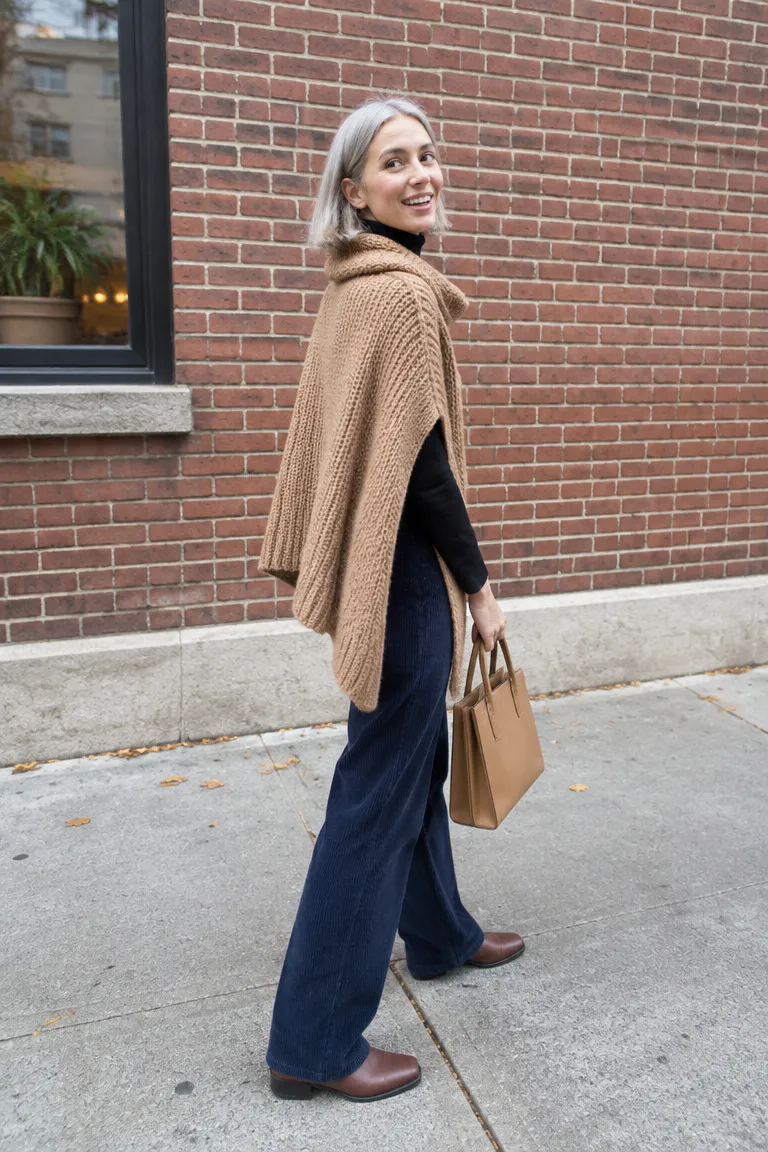
- Best for: Shorter frames, casual days, or a first cape that doesn’t commit to a big piece
- Wear it with: A black turtleneck tucked in, straight navy corduroy trousers, flat leather boots, and a top-handle tote
- Fit check: Check the cape hem against the hip, not the knee, for a lighter look. Tuck the turtleneck so the knit layer sits clean against the waistband.
- Weather swap: A knit cape is breathable, but it doesn’t block wind well, so add a scarf tucked inside the collar in gusts. Skip it entirely in wet weather and wear a coat.
A knit scarf-cape is the easiest cape for shorter or petite frames because it adds a layer without swamping the body. It drapes around the neck and shoulders instead of falling to the knee.
Pair it with straight, fitted bottoms. Navy corduroy trousers and a tucked black turtleneck keep the waist visible, and a thin belt over the cape can restore it if the style allows.
It also works as a first cape. It doesn’t commit you to a big piece, so it’s a low-stakes way to find out whether you like wearing one before you buy a full cape coat.
14. Long Cape Over Blazer and Turtleneck
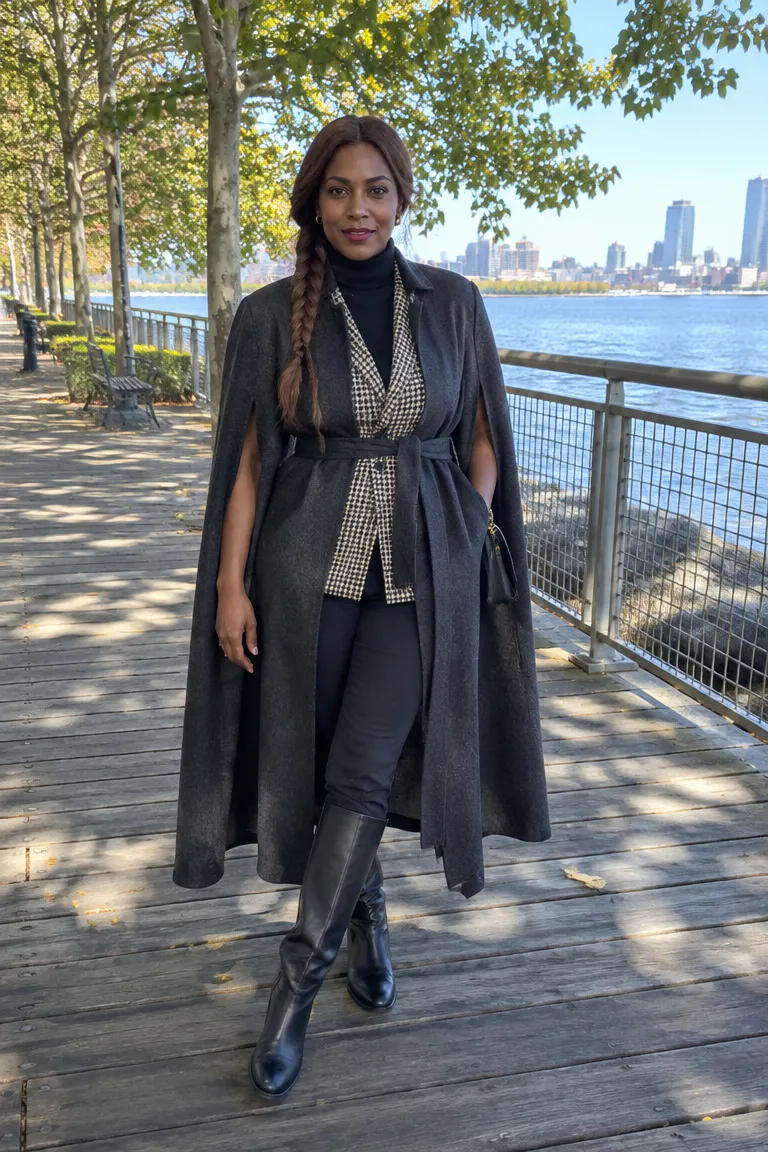
- Best for: Taller frames or anyone who wants the full poetcore layering without a heavy coat
- Wear it with: A fine merino turtleneck, a fitted houndstooth blazer, slim dark trousers, tall boots, and a cape with arm slits
- Fit check: Check that the blazer sleeves don’t bunch inside the cape and that the cape closes without pulling across the shoulder. A long cape hem at mid-calf suits taller frames, while smaller frames should check it in a mirror first.
- Weather swap: The blazer adds real insulation, but it replaces a heavy coat only on mild days or when the cape goes on top. In heavy rain, wear a raincoat over the stack instead.
This look shows how much layering fits under a cape. A houndstooth blazer sits fine under a roomy cape, and the cape avoids the sleeve bunching a coat would cause because the blazer sleeves hang inside without a second set squeezing them.
Keep the bottom half slim, with dark trousers and tall boots. The cape adds width through the body, so a narrow leg keeps the outline long. A belt over the cape marks the waist, and you can skip it on a cape that already skims the body.
Houndstooth is a small-scale check, so the cape should be solid. Charcoal works because it reads as a neutral behind black and cream.
15. Brooch, Tweed Blazer, Satchel
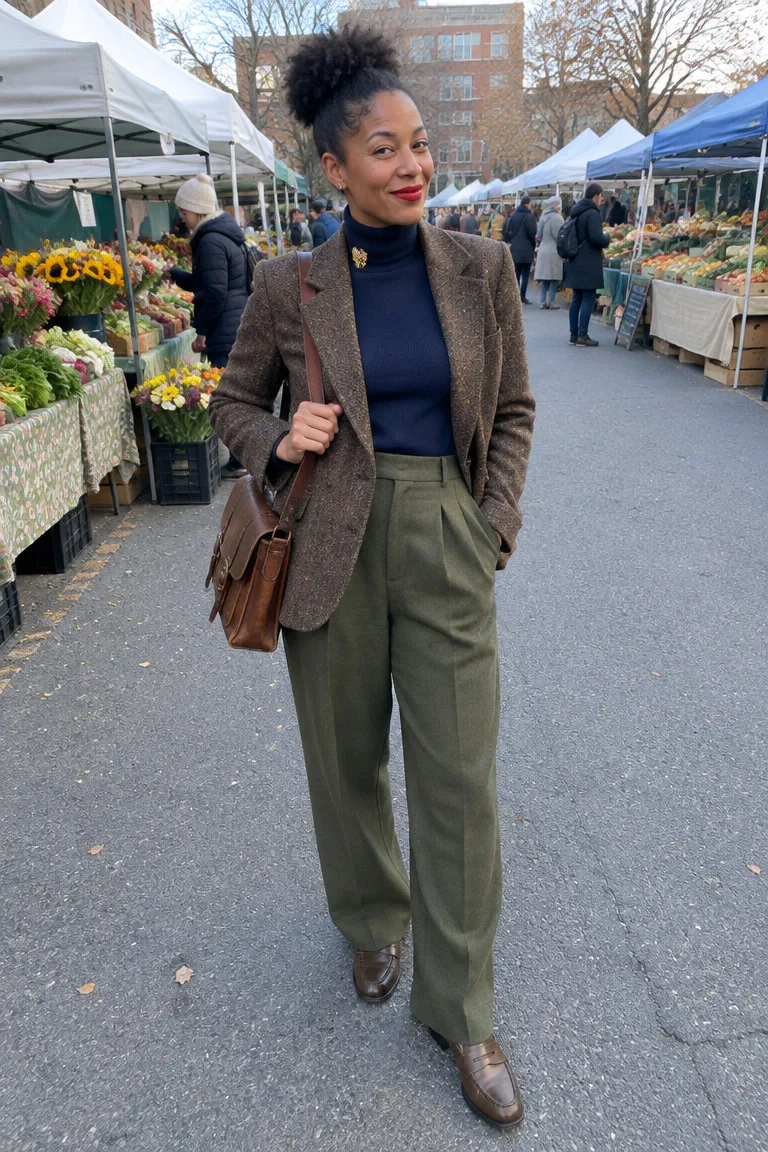
- Best for: Dressing up a basic outfit with small details, or a bookstore, class, or reading as an optional fit
- Wear it with: A navy turtleneck, a brown tweed blazer, olive pleated trousers, brown loafers, and a leather satchel worn crossbody
- Fit check: Pin the brooch through the knit’s inner layer so it doesn’t stretch the neckline. Make sure the satchel strap sits at the hip, not under the blazer lapel where it bunches.
- Weather swap: Leather satchels mark in rain, so use a waxed canvas version or carry an umbrella. Remove the brooch from delicate knits if you’re wearing a scarf that might snag it.
Restraint is what keeps poetcore from turning into costume. Pin one brooch off-center on the collar or lapel, carry a worn leather satchel, and stop there.
- Keep: one brooch, one worn leather bag, loafers, a plain belt
- Skip: a logo bag, a second statement piece such as an oversized hat, and a stack of necklaces over the knit
A logo bag breaks the look fastest. A satchel with softened corners reads as something carried for years, which suits tweed and olive wool. If the brooch is gold, echo it in the bag’s buckle or hardware.
16. Thrifted Blazer, Black Turtleneck

- Best for: Thrift runs and vintage shops where you need a quick pass/fail check
- Wear it with: A black turtleneck, plain dark trousers, loafers, and a tweed blazer in charcoal-brown
- Fit check: Go by the shoulder seam and neck fit, not the size tag, since vintage sizing runs differently from modern. Wear a turtleneck to try it on so you can test room across the back and arms.
- Weather swap: If the lining is stained or the wool smells of old storage, air it out before wearing under a coat. For a rainy trip, carry the blazer in a bag and put it on once indoors.
Inspect in this order, because the first item decides whether the rest matters. A tailor can shorten sleeves or take in a waist, but a shoulder can’t be easily rebuilt.
- Shoulders: the seam should sit at the edge of your shoulder, with no dents or puckers below it.
- Underarm lining: look for stains, tears, or sticky patches.
- Seams and buttonholes: tug gently along the back and sleeve seams, and check buttonholes for fraying.
- Needle holes: in vintage polyester, small holes from removed tags or pins are permanent.
Padded shoulders usually point to a 1980s cut, while softer shoulders point to earlier decades. Choose by the silhouette you’ll actually wear.
Pass or fail: If the shoulders fit and the lining is intact, buy it. If the shoulders are off, leave it on the rack, however good the fabric feels.
Build Your Poetcore Winter Kit
Start with the five-piece kit in two neutral colors, such as charcoal and cream, so every piece works with every other. Try each thrifted blazer over your thickest turtleneck before buying, and keep a pair of opaque tights and a small umbrella in your bag for wet days.